Artículo: How to Gua Sha for Lymphatic Drainage: Step-by-Step
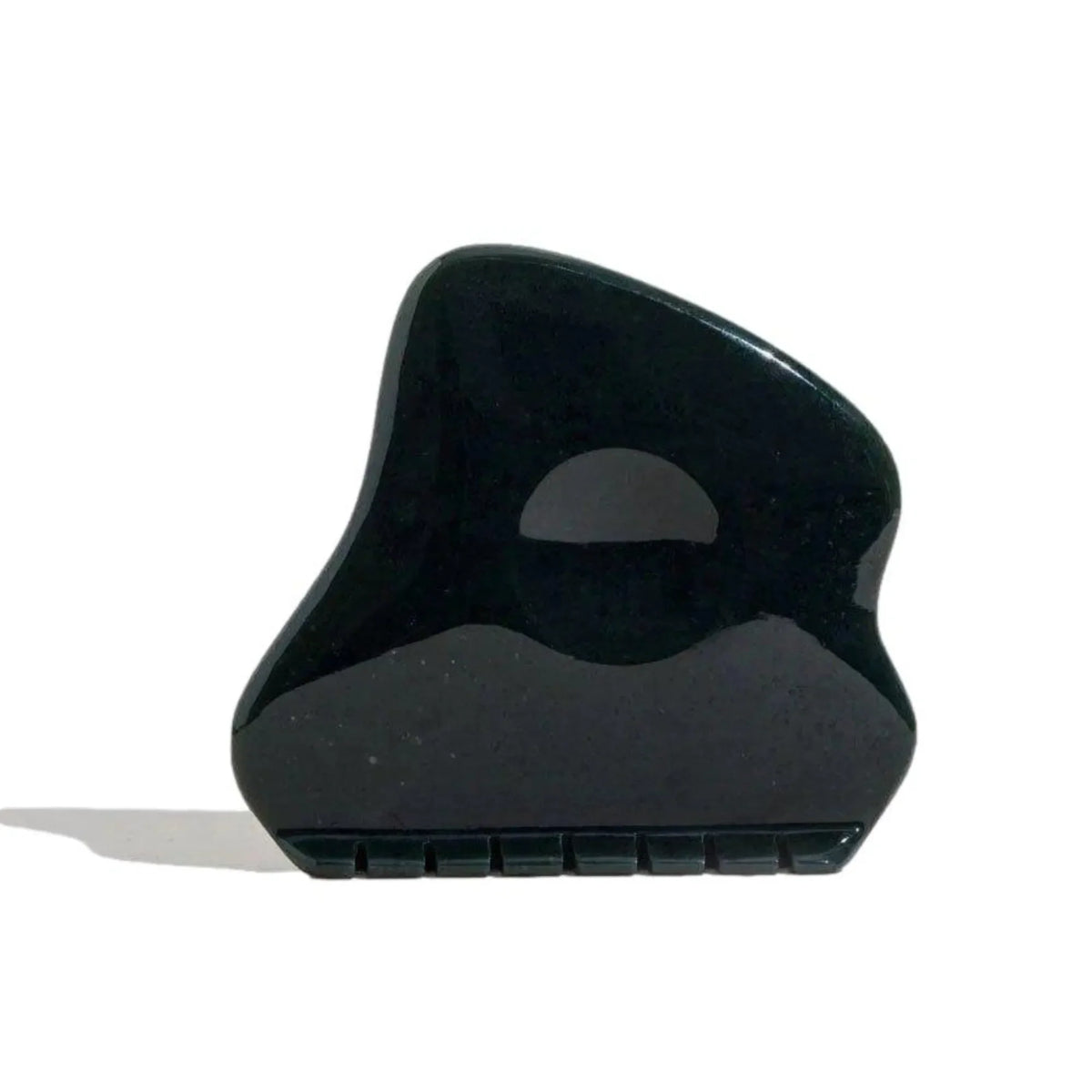
How to Gua Sha for Lymphatic Drainage: Step-by-Step
Short answer: To gua sha in a lymphatic drainage style, start at the base of your neck, then work upward in zones: neck, jaw, cheeks, under the eyes and forehead, always stroking outward and down toward the ears, the sides of the neck and the collarbone. Hold the stone almost flat, use feather-light pressure over a moisturizer for slip, and repeat each stroke three to five times. The result is cosmetic: a less puffy look for a few hours.
Key takeaways
- Order matters more than the stone. Begin and end at the neck and collarbone, and work the face from the center outward.
- Pressure should be light enough to move only the skin. If skin turns red or it aches, you are pressing too hard.
- A full sequence takes five to ten minutes. Mornings suit it best, because that is when faces tend to look puffiest.
- The depuffed look is real but temporary, usually lasting hours, not days. Consistency is what makes it a habit worth keeping.
- Evidence on facial gua sha is limited to a few small studies. Treat it as a pleasant cosmetic step, not a health treatment.
- Real, lasting or one-sided swelling is a matter for a doctor or a certified lymphedema therapist, never a face tool.
If you are new to gua sha altogether, start with my guide to what a gua sha tool is, whether it works and how to use one. This post picks up where that one stops. It is only about the lymphatic drainage style of facial massage: which direction each stroke goes, the order of the face zones, how hard to press, and how long and how often to do it.
How do you use a gua sha tool for lymphatic drainage?
Apply a moisturizer or facial oil so the stone glides. Hold the tool almost flat against your skin, at roughly 15 degrees. Begin with long, light strokes down the sides of your neck to the collarbone, then work the face zone by zone, always moving outward toward the ears and finishing down the neck again.
In my treatment room, the difference between a gua sha that leaves a face looking calmer and one that leaves it pink and blotchy is almost always technique, not the stone. The lymphatic style is slower and lighter than most people expect. Think of it as stretching the skin gently in one direction, not scraping it.
Before you start
- Start with clean skin. Cleanse first so you are not pushing makeup or sunscreen around. A balm cleanser such as Boho Cleansing Balm rinses clean and leaves skin soft rather than tight.
- Add slip. Press in a generous layer of moisturizer or a few drops of facial oil. The stone should glide. If it tugs or squeaks, add more product.
- Relax your shoulders and jaw. Sit upright with your chin level. Clenching makes the jaw strokes uncomfortable.
- Check the edge. Run it lightly along the back of your hand. Any chip or rough spot means the stone is not ready for your face.
Which way should each stroke go, and in what order?
Strokes run from the center of the face outward, then down the neck. On the cheeks and jaw they travel out and slightly up toward the ear. You are following the map manual lymphatic drainage therapists use, toward where lymph nodes sit: in front of the ears, under the jaw, along the neck and above the collarbone.
Here is the sequence I teach. Do each stroke three to five times on one side, then repeat it on the other side before moving to the next zone.
| Step and zone | Where the stroke starts and ends | Edge and pressure |
|---|---|---|
| 1. Collarbone | Just above the collarbone, sweeping outward from the center toward the shoulder | Long flat edge, very light. This is a warm-up, so keep it slow |
| 2. Sides of the neck | From just below the ear, straight down the side of the neck to the collarbone | Long flat edge, feather-light. Avoid the front of the throat |
| 3. Jaw | From the center of the chin along the jawline to just below the ear, then down the neck | The notched edge hugs the jawbone. Light to medium, never digging in |
| 4. Cheeks | From beside the nose, outward and slightly upward across the cheek to the front of the ear | Long curved edge, flat to the skin, light |
| 5. Under the eyes | From the inner corner, along the orbital bone, out to the temple | Smallest rounded corner, the lightest pressure of the whole sequence. Stay on the bone, never on the eyelid |
| 6. Forehead | From the center of the forehead out to the temple, then a short stroke down in front of the ear | Long flat edge, light |
| 7. Finish at the neck | Repeat step 2, from below the ear down to the collarbone | Long flat edge, feather-light. End here every time |
Two small habits make this work better. First, lift the stone off your skin at the end of each stroke and return it to the start, rather than dragging it back. Second, keep the stone moving in one direction only. Back-and-forth scrubbing is the fastest way to irritated, blotchy skin.
How much pressure should you use, and how long should it take?
Use about the pressure you would use to stroke a cat. The lymphatic style moves the skin, not the muscle underneath, so pressing harder adds nothing. A full sequence takes five to ten minutes. Many people use it in the morning, a few times a week or daily if skin stays comfortable.
| Question | What I recommend | Why |
|---|---|---|
| Pressure | Light enough that skin moves but does not turn red. No aching, no streaks | Firm scraping is a different technique. On the face it mostly leaves redness, and delicate skin can mark |
| Angle | Almost flat, about 15 degrees from the skin | A flat stone spreads pressure over a wider area, so it feels gentle and glides evenly |
| Repetitions | Three to five strokes per area, per side | Enough to cover each zone without going over the same patch until it gets warm and pink |
| Session length | Five to ten minutes for the full sequence | Longer is not better. If skin is flushing, stop early |
| Time of day | Morning, after cleansing and before sunscreen | Faces often look puffiest after lying flat while you sleep, so that is when the change is easiest to see |
| Frequency | Two or three mornings a week to start, up to daily if skin stays calm | The look fades within hours, so regular, gentle sessions matter more than one long one |
Finish with sunscreen in the morning. Gua sha is a massage step, and it does not replace any part of the routine that protects your skin.
How long does it take to see results from a gua sha tool?
The depuffed look, if you see one, usually shows up straight after a session and fades within a few hours. Nothing about that is cumulative in a proven way. In the one small trial of facial tools, people massaged ten minutes, five times a week, for eight weeks before measurements were compared.
So set your expectations in two layers. The quick layer is how your face looks this morning: a little less puffy around the eyes and jaw, and skin that feels relaxed. That is what most of my clients notice, and it is the honest reason to keep a stone by the sink. The slow layer is any change over weeks, and there the evidence is thin. Anyone who promises a lifted, sculpted or slimmer face from a stone is promising more than the research shows.
A few things make the quick layer more noticeable: doing the sequence in the morning, keeping pressure light, and giving the neck strokes as much time as the face. Salt, alcohol, short sleep and allergies all affect how puffy a face looks, and a stone cannot outwork them.
Do you need a gua sha stone or jade roller to do lymphatic drainage properly?
No. You can follow the same sequence with clean fingertips and a little moisturizer. A tool simply makes the strokes easier to keep light and even, and a cool stone feels pleasant on a puffy morning. A flat stone covers the jaw and neck well; a roller is quicker but less precise.
| Option | Good for | Less good for | My take |
|---|---|---|---|
| Fingertips | Under the eyes, travel, anyone who wants to try the sequence before buying anything | Long, even strokes down the neck; hands warm up fast | The best place to start. If you enjoy the habit, a stone makes it easier |
| Gua sha stone | The jawline, cheeks and neck, where a long flat edge follows the face | Anyone who presses hard by habit | The most control for the lymphatic sequence above |
| Jade roller | A quick, cooling pass over the cheeks and forehead | The jaw and the sides of the neck; the narrow wheel covers little area | Fine for a two-minute morning step, less precise for the full sequence |
| Gua sha comb | Scalp massage, plus light strokes on the face with its smooth edge | Under the eyes; its shape is built for the scalp first | A good value pick if you want one tool for scalp and face |
Material matters less than shape and finish. A smooth, polished edge with no chips, a weight that feels comfortable in your hand, and a stone you will actually keep clean are what count. If you already own a roller or a stone from another brand, use it. Technique is the part that makes the difference.
Can I drain my lymphatic system myself?
Gentle facial massage at home is a cosmetic habit that can help a face look less puffy and feel relaxed. It is not a medical treatment. Real lymphedema, or swelling that is persistent, painful or on one side only, needs a doctor or a certified lymphedema therapist, not a face tool.
Manual lymphatic drainage is a genuine clinical therapy. Trained therapists use it, usually alongside compression and exercise, for people with lymphedema after cancer treatment or surgery. A Cochrane review of manual lymphatic drainage after breast cancer treatment found any added benefit was modest and seen mainly in milder cases. That research is about a medical therapy delivered by trained professionals. It is not evidence for facial gua sha, and it is not evidence for any Bohemia Skin product.
See a doctor before you reach for a stone if you notice any of these:
- Swelling that lasts for days, keeps coming back, or appears on one side of the face or neck only.
- A lump, or a tender, hard or growing spot under the jaw, along the neck or above the collarbone.
- Swelling with fever, pain, warmth or redness that spreads.
- Swelling after surgery, radiation, dental work or an injury.
- A history of lymphedema, cancer treatment or lymph node removal. Ask your care team or a certified lymphedema therapist before any self-massage.
What does the research on facial gua sha actually say?
Honestly, not much yet. The research on facial gua sha is limited to a few small studies, and none measured lymphatic flow in the face. What exists is useful context for how the technique feels and looks. It is not proof that any tool, ours included, changes how your body works.
- Microcirculation, on the back. A 2007 pilot study in 11 healthy volunteers measured blood flow in the skin after traditional gua sha and found a short-lived local increase. That was firm, body-style gua sha on the back, not a light facial sequence, which is why I mention it as background only.
- Facial tools, one small trial. A 2025 randomized trial of 34 women compared facial gua sha with a facial roller, ten minutes, five days a week, for eight weeks. Both groups showed small measured changes in facial contour. There was no group that did nothing, participants knew which tool they used, and the study measured no lymphatic outcome.
- Clinical lymphatic drainage. The Cochrane review above covers therapist-delivered drainage for lymphedema, a medical setting with its own training and equipment.
I keep this research separate from what I say about our stone on purpose. The claim I am comfortable making for any gua sha tool is the cosmetic one: a few minutes of light massage can help skin look less puffy and feel more relaxed for a while.
Who should skip gua sha or ask a doctor first?
Facial gua sha is gentle, but it is still friction on the skin, and some skin needs a pause or a professional opinion first. Skip it, or check with a dermatologist, your doctor or your injector before you start, if any of these apply to you:
- Active breakouts. Do not glide over inflamed spots. If your skin is breakout-prone, work only on clear areas, or wait until skin is calm.
- Broken, sunburned or freshly treated skin. Cuts, scabs, a peel, laser, microneedling or waxing: wait until your provider says skin has fully settled.
- Recent fillers or injectables. Ask your injector how long to wait before any facial massage. Pressure can affect how fresh product sits.
- Blood thinners, or skin that bruises easily. Ask your doctor first, and keep pressure feather-light if you go ahead.
- A rosacea flare, or rosacea-prone skin. The American Academy of Dermatology's rosacea skin care tips advise against rubbing or massaging skin with rosacea. Skip gua sha during a flare, and ask a dermatologist before you add it at all.
- Visible broken capillaries or very thin skin. Go lighter than you think, or use fingertips instead.
- Unexplained swelling or lumps, or a history of lymphedema. See the doctor list above.
If your skin turns red for more than a few minutes, stings, or you see tiny dots or bruising, you pressed too hard or went over the same area too often. Stop for a few days, then try again with lighter strokes and fewer passes. If your skin is already stinging from other products, my guide on how to tell if your skin barrier is damaged is the better place to start.
What do we make for this, and when should you wait?
Honest version first: you do not need to buy anything to try this. Fingertips and the moisturizer you already own will tell you whether you enjoy the habit. If you do, here is what we carry and how I would use it for the sequence above.

The massage step
A cooling nephrite jade stone for the massage step of your routine. Its polished, naturally cool surface glides over skin so you can work a moisturizer in slowly. Used with light strokes, it helps skin look less puffy and feel less tense. Always use it over a moisturizer or oil so it glides rather than drags.
$74.99

Scalp and face
A dual-purpose jade comb, 2.25 by 4 inches. On the scalp, use small zigzag strokes with light pressure for a relaxed feel. On the face, use its smooth edge with light strokes over a moisturizer. Best if you want one tool for both.
$19.99

The slip layer
A lightweight cream with ceramides NP, EOP and AP, hyaluronic acid, beta glucan and a firming peptide. It gives a stone enough slip to glide comfortably, helps skin hold moisture and helps calm the look of redness. Lightly scented with lavender and vanilla, so it is not fragrance free. 1.7 oz (50 mL).
$64.99
Auto Refill: 20% off every order at $51.99, every 8, 10 or 12 weeks. Skip, change, or cancel anytime.
How I use them together: cleanse, press a generous layer of Infinite Aura over your face and neck, then run the sequence above with the stone. If you use Kay's Glow Oxygen Serum, mix it into Infinite Aura first, on the top of the Aura container, then press the mix in before you start. Kay's Glow Oxygen Serum contains AHAs, so wear sunscreen every morning while you use it. Keep the stone over clear skin only, and finish with sunscreen in the morning.
To see how the massage step fits a full cleanse, treat and seal routine, browse our Bohemia Skin routines.
Frequently asked questions
Should I gua sha in the morning or at night?
Morning is the best time for the lymphatic sequence, because faces tend to look puffiest after lying flat while you sleep, so the change is easiest to see. Do it after cleansing and before sunscreen. Evening works too if you mainly enjoy it as a way to unwind, and it pairs well with your night moisturizer.
Should my gua sha stone be cold?
Cool feels lovely on a puffy morning, and jade is naturally cool to the touch. A few minutes in the fridge is fine if you like it colder. Skip the freezer: a very cold stone can be uncomfortable on the skin, and sudden temperature changes are hard on natural stone. Let a chilled stone sit for a moment before using it.
Can I use gua sha under my eyes?
Yes, with care. Use the smallest rounded corner and the lightest pressure of the whole sequence, gliding from the inner corner along the bone toward the temple. Stay on the orbital bone and never press on the eyelid or the eye itself. If the skin there is thin or marks easily, use your ring finger instead of the stone.
Why does my skin turn red after gua sha?
A light pink flush that fades within a few minutes is normal. Redness that lasts, tiny red dots or bruising mean you pressed too hard, held the stone too upright, or went over one spot too often. Rest your skin for a few days, then go back with a flatter angle, lighter pressure and three to five strokes per area.
What should I put on my face before gua sha?
Use something with enough slip that the stone glides without tugging: a moisturizer, a facial oil or a serum layered under a moisturizer. Water-light serums alone tend to absorb too fast. Infinite Aura Moisturizer gives comfortable slip, but it is lavender scented, so choose a fragrance-free option if scent bothers your skin.
Can I gua sha if I have acne-prone skin?
You can, with two rules. Never glide over active or inflamed breakouts, and clean your stone after every use. Work only on clear areas, or wait until skin is calm. If you are breakout-prone, a lighter moisturizer usually suits you better than a heavy oil. Painful or deep breakouts are worth showing to a dermatologist.
How do I clean my gua sha stone?
Wash it after every use with mild soap and lukewarm water, rinse well and dry it with a clean towel. Avoid hot water and harsh cleaners on natural stone. Store it in a pouch or a clean, dry spot where it will not be knocked, because a chipped edge can scratch skin. Keep your stone to yourself rather than sharing it.